

1. Why French People Interrupt: Is It Rude?
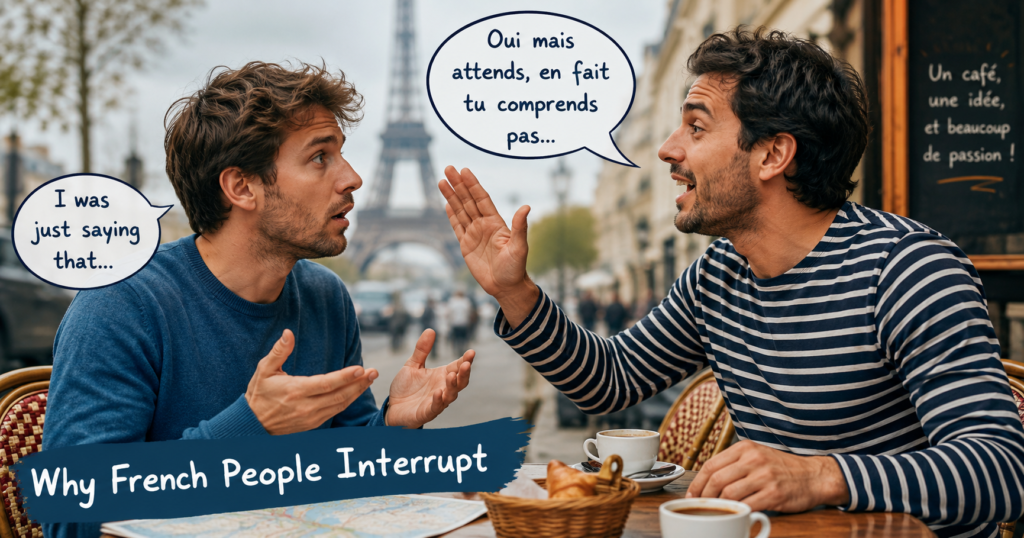
If you’re moving to France, or have recently arrived, and you are used to converations where people wait patiently until the other person has completely finished speaking, you may notice that French conversations can sometimes feel like a tennis match played at very high speed.
You start speaking.
Someone reacts.
You continue.
They interrupt.
You try to finish your sentence.
Someone else adds something.
And suddenly three people are talking.
So… are French people being rude?
Not necessarily.
Understanding French conversation means learning that an interruption doesn’t always mean the same thing.
An interruption can mean many things
When someone interrupts you in France, they may be:
- showing that they are listening;
- reacting to what you just said;
- agreeing enthusiastically;
- disagreeing;
- asking for clarification;
- adding an example;
- telling a related story;
- finishing your sentence;
- simply getting excited about the conversation.
For example:
You: J’ai visité le Pays basque le week-end dernier…
French friend: Ah oui ? Où ça ?
You: À Saint-Jean-de-Luz, et…
French friend: J’adore Saint-Jean-de-Luz !
The person hasn’t necessarily stopped listening.
They are participating in the conversation.
Waiting silently can sometimes feel strange
In some cultures, showing respect means allowing someone to finish before responding.
In French conversations, a long silence can sometimes feel uncomfortable.
People often react quickly:
Ah oui !
Exactement !
C’est vrai !
Mais attends…
Non, justement !
Ah bon ?
Et après ?
These little reactions are part of the rhythm of the conversation.
But there is a difference between interrupting and being rude
Of course, French people can interrupt rudely.
If someone repeatedly prevents you from finishing, ignores what you’re saying or dominates the conversation, that’s different.
The important thing is to look at the whole interaction, not just the fact that someone interrupted.
What should you do?
If you’re speaking French and someone interrupts you, don’t automatically stop.
You can continue your sentence.
For example:
French person: Ah oui, moi aussi j’ai été à…
You: Oui, justement, je voulais te raconter…
Or:
« Attends, laisse-moi finir !«
This can be perfectly natural between friends.
A softer version:
« Attends, je termine juste ma phrase ».
(« Just let me finish my sentence. »)
Don’t be afraid to interrupt
If you’re always waiting for the perfect moment, you may never participate fully in a lively French conversation.
You can use small reactions yourself:
Ah oui ?
Vraiment ?
Je vois.
Exactement !
C’est intéressant.
Et ensuite ?
These expressions show that you’re engaged.
A useful distinction
French conversation is not necessarily about taking turns as neatly as in a formal interview.
It’s often about reacting to each other.
The conversation itself creates the rhythm.
That’s one reason why intermediate learners can find native French conversations exhausting: you aren’t only trying to understand the vocabulary. You’re also trying to understand when and how to react.
Try this
Next time you’re in a French conversation, don’t concentrate only on speaking correctly.
Listen for the small reactions people make.
Notice:
- when they interrupt;
- why they interrupt;
- how they show agreement;
- how they disagree;
- how they encourage someone to continue.
You’ll start seeing interruptions differently.
Want to become more comfortable with real French conversation?
In my conversation workshops, I don’t simply listen while you speak and then correct your mistakes. I actively participate in the conversation, so you can practise reacting, understanding and expressing yourself naturally.
2. French Humour Explained: Why Don’t I Always Get the Joke?
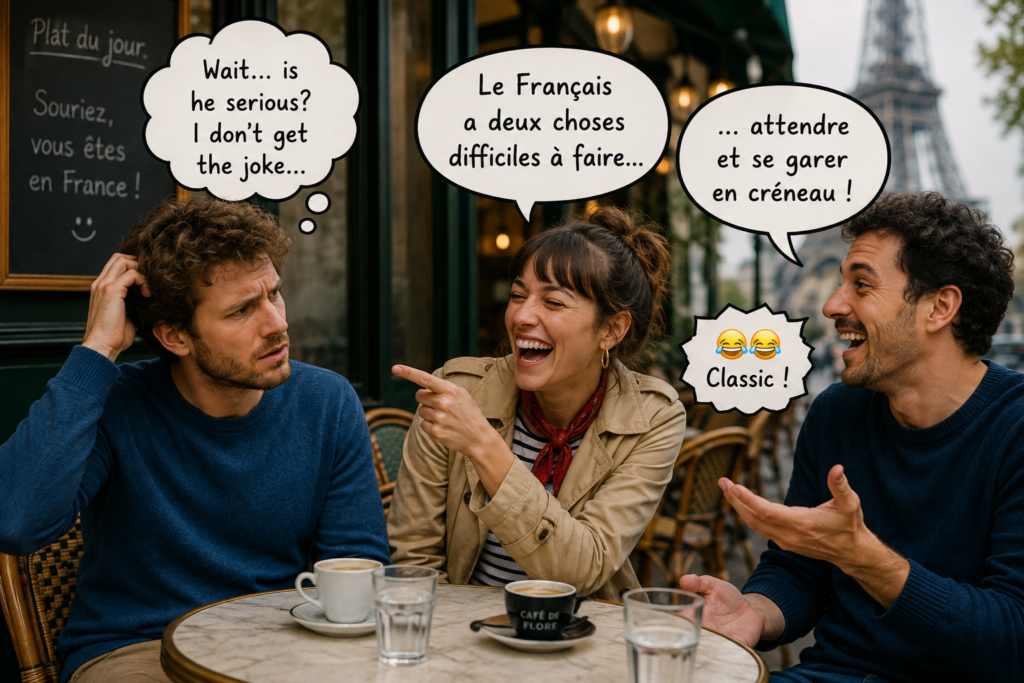
One of the strangest moments when living in another country is laughing five seconds too late.
Everyone around you is laughing.
You smile.
You look around.
You have absolutely no idea what was funny.
If you’re just moving to France, welcome to French humour.
The problem isn’t necessarily your French.
Humour is deeply connected to language and culture.
French humour can be very dry
French people can say something completely seriously when they actually mean the opposite.
For example:
Il fait super beau aujourd’hui !
…said while it’s raining heavily.
The speaker isn’t necessarily confused.
They’re being ironic.
You need to understand the context and the tone.
Irony is everywhere
Imagine someone arrives at work 30 minutes late.
Their colleague says:
Ah, tu es en avance aujourd’hui !
Literally:
« Oh, you’re early today! »
They’re obviously not saying the person is early.
They’re making fun of the fact that they’re late.
If you take the sentence literally, the joke disappears.
French humour often depends on exaggeration
Someone tells you:
J’ai attendu trois heures !
Maybe they actually waited 45 minutes.
The exaggeration is part of the expression.
You may hear:
Je meurs de faim.
« I’m starving to death. »
Or:
J’ai mille choses à faire.
« I have a thousand things to do. »
Obviously, nobody is literally dying or counting a thousand tasks.
French uses exaggeration very naturally.
Making fun of yourself is common
Self-deprecating humour is also frequent.
Someone makes a mistake and says:
Bravo, champion !
They are making fun of themselves.
Or:
Je suis vraiment doué…
Literally:
« I’m really talented… »
when they have just done something stupid.
Again, tone matters.
Humour can sometimes sound rude
This is where cultural differences become complicated.
A French person may tease you because they feel comfortable with you.
For example:
Alors, toujours en retard ?
« Still late? »
Depending on the relationship and tone, this can be affectionate teasing rather than criticism.
But humour isn’t universal.
What one person considers funny, another may find offensive.
You should never assume that every apparently rude comment is « just French humour. »
Context matters.
How can you tell when someone is joking?
Look at:
- tone of voice;
- facial expression;
- exaggeration;
- context;
- relationship between the people;
- what was said immediately before.
And listen for expressions such as:
Je plaisante !
« I’m joking! »
Je rigole !
« I’m kidding! »
C’est pour rire.
« I’m only joking. »
You don’t have to understand every joke
This is important.
Even French people don’t understand every joke.
Humour can involve politics, television, celebrities, regional references, wordplay or cultural references.
As a language learner, you will inevitably miss some.
Don’t panic.
Understanding humour develops gradually as your cultural and linguistic knowledge grows.
A useful strategy
If you don’t understand why everyone is laughing, you can simply ask:
Pourquoi ? J’ai pas compris !
Or:
C’est quoi la blague ?
With friends, that’s completely normal.
Sometimes the explanation is actually funnier than the joke.
3. French Politeness: The Little Rules That Make a Big Difference when moving to France
You’ve probably learned bonjour and merci.
But French politeness is more complicated than learning a list of polite words.
There are small social rules that can completely change how an interaction feels.
And one of the most important is surprisingly simple:
Say « Bonjour » before asking for something
Imagine entering a small bakery.
You walk up to the counter and say:
Vous avez des croissants ?
Technically, the sentence is perfectly understandable.
But it can sound abrupt.
A much more natural approach is:
Bonjour ! Vous avez encore des croissants ?
The difference is tiny.
The social effect is much bigger.
« Bonjour » opens the interaction
Think of bonjour as a social door.
You acknowledge the person before asking them for something.
This applies in many situations:
At a shop:
Bonjour, je voudrais…
At reception:
Bonjour, j’ai rendez-vous avec…
At the doctor’s:
Bonjour, j’ai rendez-vous à dix heures.
When entering a small business:
Bonjour !
Even when you think the person obviously knows you’re there, the greeting matters.
« Merci » and « s’il vous plaît »
These are basic, but don’t underestimate them.
Je voudrais un café, s’il vous plaît.
Merci beaucoup.
Merci, bonne journée !
These expressions make interactions smoother.
« Vous » and « tu »
Choosing between vous and tu can be confusing.
Generally, vous is safer when:
- you don’t know the person;
- you’re in a professional situation;
- you’re speaking to an older person you don’t know;
- you’re dealing with a service provider.
Tu is used with:
- friends;
- family;
- children;
- people with whom you have established an informal relationship.
But there are many exceptions.
In modern France, people may move to tu quite quickly, particularly in informal environments.
If someone says:
On peut se tutoyer ?
they are suggesting that you use tu.
You can simply answer:
Oui, bien sûr !
Politeness isn’t necessarily about saying « please » constantly
French politeness is also about how you formulate requests.
Compare:
Donnez-moi ça.
with:
Je voudrais celui-ci, s’il vous plaît.
Or:
Vous pouvez m’aider ?
with:
Est-ce que vous pourriez m’aider, s’il vous plaît ?
The second version is softer.
Don’t forget the goodbye
When you leave a small shop or finish an interaction, saying:
Au revoir, bonne journée !
is natural.
You may also hear:
Bonne journée !
Bonne soirée !
Bon courage !
The last one can be particularly interesting.
Bon courage ! doesn’t literally mean « good courage ».
It can mean something like:
« Hang in there! »
or
« Have a good one! »
depending on the situation.
The golden rule
If you’re unsure what to do:
Greet first. Ask politely. Thank the person. Say goodbye.
These four little habits will make everyday interactions much easier.
4. French Body Language: What Are People Actually Saying?
Learning French isn’t only about words.
French people communicate with their hands, faces, eyes, shoulders and body posture too.
And sometimes the body says something completely different from the words.
The famous French shrug
You may see:
Shoulders raised.
Eyebrows slightly lifted.
Hands open.
Maybe a little pursing of the lips.
This can mean:
Je sais pas.
« I don’t know. »
Or:
Qu’est-ce que tu veux que j’y fasse ?
« What do you expect me to do? »
Or simply:
« Who knows? »
The exact meaning depends on the context.
The « bof » face
French speakers often use facial expressions together with:
Bof…
This can mean:
« Not really. »
« Meh. »
« Nothing special. »
For example:
Le film était bien ?
Bof…
That’s not exactly « no ».
It’s closer to:
« It was… okay. »
The famous « mouais »
You may also hear:
Mouais…
This expresses doubt or lack of enthusiasm.
Imagine:
Tu penses que ça va marcher ?
Mouais…
The person is definitely not convinced.
Eye contact
Eye contact is an important part of conversation.
If someone looks at you while you’re speaking, it generally shows engagement.
But don’t overanalyse it.
Different people have different communication styles.
Gestures can reinforce meaning
French speakers may use their hands naturally while explaining something.
For example:
C’est juste à côté.
They may point.
Or:
C’est énorme !
Their hands may show the size.
Or:
J’en ai marre !
Their facial expression and body language may reinforce the frustration.
Don’t try to copy every gesture
This is important.
You don’t need to become a caricature of a French person.
Observe first.
As your French becomes more comfortable, many gestures will become natural because you’ll understand the emotional meaning behind them.
Watch the whole interaction
Never interpret one gesture in isolation.
A raised eyebrow could mean surprise, doubt, amusement or disagreement.
The words, tone, facial expression and context all work together.
That’s exactly what makes real-life communication more complicated — and more interesting — than textbook French.
5. Why French People Seem Rude: Are They Really?
One of the most common complaints from newcomers moving to France is:
« French people are rude. »
Sometimes someone really is rude.
But quite often, something else is happening.
The first problem: expectations
People from different cultures have different ideas about politeness.
In one country, a friendly smile and enthusiastic small talk may be normal.
In another, a stranger may prefer to keep more distance.
Neither is automatically more polite.
They’re simply different.
The missing « bonjour »
This is one of the easiest ways to create a bad first impression.
You walk into a shop and immediately ask:
Vous avez ça ?
The shopkeeper may appear cold.
Try:
Bonjour ! Excusez-moi, vous avez ça ?
The interaction may suddenly feel completely different.
French people don’t always smile at strangers
In some cultures, smiling at customers or strangers is expected.
In France, a person can be perfectly polite without smiling constantly.
Don’t necessarily interpret a neutral expression as hostility.
Directness can sound aggressive
French people can sometimes be quite direct.
For example:
Non, ce n’est pas possible.
That can sound harsh to someone accustomed to more indirect language.
But the speaker may simply be giving you a straightforward answer.
The opposite can also happen
Sometimes French people use indirect language.
For example:
Ça risque d’être compliqué…
Literally:
« That risks being complicated. »
In context, this may mean:
« No, probably not. »
So you need to learn both sides:
- French can be direct;
- French can also be highly indirect.
Service culture can feel different
In some countries, customer service involves a lot of enthusiastic friendliness.
In France, service may sometimes feel more restrained.
That doesn’t necessarily mean the person doesn’t want to help.
The interaction may simply follow different expectations.
But don’t excuse actual rudeness
This is important.
Not every unpleasant interaction is cultural.
Sometimes someone is impatient.
Sometimes someone is having a bad day.
Sometimes someone is simply rude.
Culture explains some behaviour.
It doesn’t excuse everything.
Learn the social code
Instead of asking:
« Why are French people rude? »
try asking:
« What does polite behaviour look like in this situation in France? »
That’s a much more useful question.
6. Small Talk in France: What Do French People Actually Talk About?
Small talk can be surprisingly difficult in another language.
You may know hundreds of French words and still have absolutely no idea what to say when someone asks:
Alors, ça va ?
What exactly are you supposed to answer?
« Ça va ? » doesn’t always require a real answer
Sometimes:
Ça va ?
simply means:
« Hi, how are you? »
You can answer:
Ça va, et toi ?
You don’t necessarily need to explain your emotional state.
But if someone genuinely asks:
Comment ça va en ce moment ?
that’s different.
The context matters.
The weather is always available
Yes, French people talk about the weather.
Especially:
Il fait chaud !
Il fait froid !
Quel temps !
C’est fou, cette chaleur !
Il va pleuvoir ?
It may sound trivial.
But small talk is often about creating a moment of connection rather than exchanging important information.
Talk about what is happening around you
If you’re at a café:
Tu viens souvent ici ?
At an event:
Tu connais déjà cet endroit ?
At work:
Tu as passé un bon week-end ?
At a sports activity:
Tu fais ça depuis longtemps ?
These are easy conversation openers.
Ask follow-up questions
This is the key.
Someone says:
Je suis allé à Arcachon ce week-end.
Don’t just say:
Ah, sympa.
Ask:
Ah oui ? Tu y vas souvent ?
Or:
Tu étais avec des amis ?
Or:
Tu as fait quoi ?
That’s how a conversation develops.
Don’t turn small talk into an interview
Questions are useful, but conversation should go both ways.
If someone says:
Je viens de Bordeaux.
You can say:
Moi aussi, j’habite à Bordeaux depuis trois ans.
Then:
Tu es du centre ?
Now you’ve shared something and asked something.
French conversation can become personal surprisingly quickly
Depending on the relationship, French people may ask:
Tu fais quoi dans la vie ?
Tu habites où ?
Tu es marié(e) ?
Tu as des enfants ?
These questions may feel more personal than they would in some cultures.
Context and relationship matter.
The secret to French small talk
Don’t search for the perfect sentence.
React. Share. Ask. React again.
For example:
Tu as passé un bon week-end ?
Oui, super ! Je suis allé à Lacanau avec des amis.
Ah, sympa ! Tu fais du surf ?
Oui, depuis quelques années.
Moi, j’ai essayé une fois…
Now you have a conversation.
That’s much more useful than memorising 50 conversation questions.
7. Invited to a French Dinner? Here’s What You Need to Know when oving to France
Congratulations.
You’ve been invited to a French dinner.
You may now be wondering:
What time should I arrive? What should I bring? Should I help? How long will I stay? Why are we still eating three hours later?
Don’t panic.
Here are a few useful things to know.
What time should you arrive?
If you’re invited for:
20h
don’t necessarily arrive at exactly 20:00.
Depending on the context, arriving a little later can be normal.
But don’t arrive 45 minutes late without warning.
If you’re going to be late, send a message:
Désolé(e), je vais avoir une dizaine de minutes de retard.
Should you bring something?
If it’s a casual dinner, you can ask:
Je peux apporter quelque chose ?
Your host may answer:
Non, non, ne t’inquiète pas !
Sometimes they genuinely mean it.
Sometimes they may still appreciate a small gift.
A bottle of wine, flowers or something from your region can be a nice gesture.
Don’t assume dinner means one quick meal
A French dinner can involve:
Apéritif
Then perhaps:
Entrée
Plat
Fromage
Dessert
Café
And conversation throughout.
You may eventually look at your watch and discover that you’ve been sitting at the table for four hours.
This is not necessarily a problem.
The meal is often also a social experience.
The apéritif matters
The apéritif — often called l’apéro — is more than a drink.
It’s a moment to arrive, chat and relax before dinner.
You may have:
- wine;
- sparkling wine;
- beer;
- local apéro, like home made drink or something usual to drink in the area
- soft drinks;
- olives;
- nuts;
- small appetisers.
Don’t rush.
What should you say when you arrive?
A simple:
Bonsoir ! Merci de m’avoir invité(e).
is perfect.
If you know the people well:
Ça fait plaisir de vous voir !
Compliment the food
If you enjoy something:
C’est délicieux !
J’adore !
C’est vraiment très bon.
These are simple and natural.
What if you don’t like something?
You don’t need to announce:
« I hate cheese. »
at the moment the cheese arrives.
You can politely say:
Non merci, je vais passer mon tour.
« I’m going to skip this one. »
Or:
Je n’en mange pas, mais merci.
Or:
J’ai une intolérance au lactose
(The truth is, you can say almost anything if you say it politely or with humour. It all depends on how well you know the people you’re talking to. If you jokingly explain that you might be farting all day the next day and need to spare your colleagues or partner, people will probably laugh and understand. But of course, you wouldn’t make that kind of joke with a client!)
a couple I use myself as I don’t really eat dessert
» Sorry, there is really no more space »
Désolée, je n’ai vraiment plus de place, le dîner était absolument excellent. (politicaly correct)
Don’t rush away after dessert
This is perhaps the biggest cultural surprise.
The meal may technically be finished.
But the conversation isn’t.
Someone makes coffee.
People continue talking.
Another bottle appears.
Someone tells a story.
You think:
« Surely we’re finished? »
No.
You’re not finished.
Conversation is part of the meal
A French dinner isn’t simply about eating.
It’s about spending time together.
The table is a place for conversation.
And that’s one reason why improving your conversational French can make such a difference to your experience of French social life.
8. Understanding French Culture: It’s More Than Food, Wine and Baguettes
French culture is often reduced to a few familiar images:
Wine.
Cheese.
Baguettes.
Cafés.
Fashion.
Long lunches.
But if you’re living in France, the interesting cultural differences are often much smaller.
They’re hidden in everyday behaviour.
Time spent together matters
A meal can take longer than you expect.
A coffee can turn into a conversation.
An invitation for « un verre » may last considerably longer than one drink.
The point isn’t always efficiency.
Sometimes the point is simply being together.
Food is often social
Food isn’t only fuel.
People talk about food.
They discuss what they ate.
They compare restaurants.
They argue about the best way to prepare something.
They talk about regional specialities.
And yes, people can have strong opinions about cheese.
Conversation can be argumentative without being hostile
This is an important cultural difference.
Two French people can disagree enthusiastically about:
politics;
food;
football;
work;
education;
almost anything.
Raised voices don’t necessarily mean an argument has become serious.
Sometimes people simply enjoy debating.
Of course, there is a difference between a lively discussion and genuine conflict.
But don’t assume disagreement means the relationship is damaged.
There is a strong appreciation for nuance
French communication often contains expressions such as:
Ça dépend.
Peut-être.
Pas forcément.
Ça se discute.
Je ne suis pas sûr(e).
These phrases allow people to qualify what they’re saying.
Learning them can make your French sound much more natural.
Regional culture matters enormously
France isn’t culturally uniform.
Bordeaux is not Marseille.
Brittany isn’t Provence.
Paris isn’t the countryside.
Food, accents, traditions and social habits can vary considerably.
So be careful with statements beginning:
« French people always… »
There is almost certainly an exception.
The French relationship with bureaucracy
Yes, paperwork is a cliché for a reason.
But the more useful lesson for an expatriate is:
Don’t assume that the process will work exactly as it does in your home country.
Read documents carefully.
Keep copies.
Ask questions.
And, whenever possible, learn the relevant vocabulary in French.
Understanding words such as:
justificatif
dossier
pièce d’identité
attestation
rendez-vous
demande
can make administrative situations much less intimidating.
Culture is learned through participation
You don’t learn French culture by reading ten articles about France.
You learn it by:
- having dinner with French people;
- going to the market;
- talking to neighbours;
- attending local events;
- travelling around France;
- listening to conversations;
- asking questions.
And, of course, making the occasional cultural mistake.
That’s part of the adventure.
9. How to Survive Your First French Dinner: The Unwritten Rules of French Society
You are just moving to France and your first dinner invitation in France can feel like an exam you didn’t know you were taking.
Do I arrive exactly on time?
Do I kiss everyone?
Do I bring wine?
Do I sit down immediately?
Can I start eating?
Why is everyone still talking?
Relax.
There aren’t actually 147 official French dinner rules.
But there are a few useful unwritten ones.
Rule 1: Say « Bonjour » to everyone
When you arrive, don’t simply walk into the room and start looking for the wine.
Say:
Bonsoir !
Then greet the people you know.
Depending on the relationship, this may involve la bise.
If you’re unsure, follow the host’s lead.
Rule 2: Don’t arrive empty-handed if you’ve been invited socially
You don’t necessarily need to bring something expensive.
A small gesture is enough.
You could bring:
une bouteille de vin
des fleurs
une spécialité de votre région
Or ask:
Je peux apporter quelque chose ?
Rule 3: Don’t start eating before everyone is ready
If there are several people at the table, wait.
The host may say:
Bon appétit !
Then you can start.
Rule 4: Don’t rush
This is probably the biggest difference for many expatriates.
Dinner is not necessarily a sequence of:
eat → finish → leave.
The meal is the event.
Conversation is part of it.
Rule 5: Participate in the conversation
You don’t need perfect French.
Listen.
React.
Ask questions.
Share something.
You can use simple expressions:
Ah bon ?
C’est vrai ?
Je ne savais pas !
Et toi ?
Qu’est-ce que tu en penses ?
These little phrases help you participate even when your vocabulary is limited.
Rule 6: Don’t panic if people talk quickly
This will happen.
Especially when several French people are talking together.
Don’t try to understand every single word.
Listen for:
- the main subject;
- familiar words;
- tone;
- names;
- repeated expressions.
If you miss something important:
Pardon, j’ai pas compris.
Or:
Vous pouvez répéter ?
There’s nothing embarrassing about it.
Rule 7: French people may disagree
Don’t panic if someone says:
Non, je ne suis pas d’accord.
That doesn’t necessarily mean the evening is ruined.
Discussion and disagreement can be perfectly normal parts of conversation.
You can answer:
Ah bon ? Pourquoi ?
and continue.
Rule 8: Don’t disappear immediately after eating
If you’re invited for dinner, expect to spend time together.
Coffee may come after dessert.
Then conversation.
Then another conversation.
Maybe another drink.
The meal may be officially finished, but socially it isn’t.
Rule 9: Thank your hosts
Before leaving:
Merci, c’était vraiment très sympa.
Or:
Merci beaucoup pour le dîner, c’était délicieux.
And the next day, a message can be a lovely gesture:
Merci encore pour hier soir, j’ai passé une très bonne soirée !
Simple.
Natural.
Perfect.